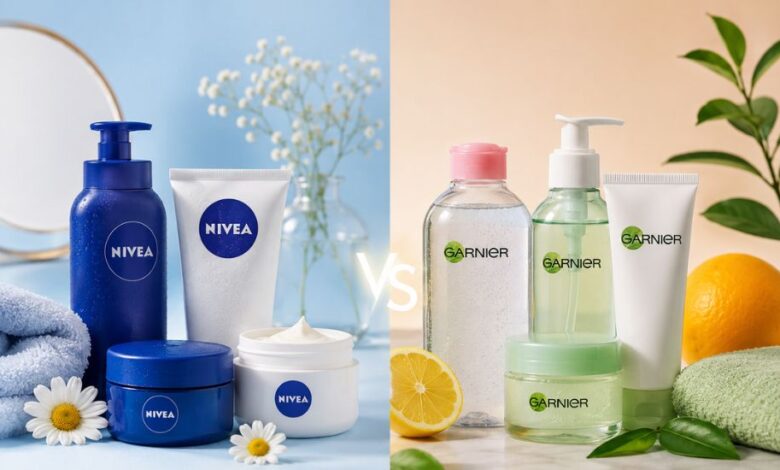
Skincare can feel confusing for beginners because every brand claims to be “best,” “dermatologist recommended,” or “perfect for glowing skin.” Two of the most commonly compared drugstore brands are Nivea and Garnier. Both are affordable, widely available, and beginner-friendly—but they work in very different ways.
If you’re asking: “I’m a skincare beginner. Is Nivea a good starting brand compared to Garnier?” — the honest answer is: yes, but it depends on your skin type and goals.
This article breaks down everything in a simple, practical way so you can choose the right starting point without damaging your skin barrier or wasting money.
🧴 Understanding the Two Brands First
🌿 Nivea – Barrier & Hydration Focused Brand
Nivea is one of the oldest skincare brands in the world, known for:
- Heavy moisturization
- Simple formulas
- Barrier protection
- Low-complexity skincare routines
Nivea products are usually built for:
- Dry skin
- Normal skin
- Sensitive skin (in many cases)
Key idea:
Nivea focuses on keeping skin protected and hydrated, rather than targeting acne or pigmentation aggressively.
🍊 Garnier – Active Ingredient & Treatment Focused Brand
Garnier is more modern and trend-driven. It focuses on:
- Vitamin C (brightening)
- Salicylic acid (acne control)
- Niacinamide (oil control & glow)
- Micellar cleansing solutions
Garnier is designed for:
- Oily skin
- Acne-prone skin
- Uneven skin tone
- People wanting visible results quickly
Key idea:
Garnier focuses on treating skin concerns using active ingredients, not just moisturizing.
🧪 Nivea vs Garnier: Core Difference (Simple View)
| Feature | Nivea | Garnier |
|---|---|---|
| Main goal | Hydration & barrier care | Skin treatment & correction |
| Best for beginners | Yes (very simple) | Yes (but slightly advanced) |
| Skin type focus | Dry & sensitive skin | Oily & acne-prone skin |
| Product complexity | Low | Medium |
| Active ingredients | Minimal | High |
| Risk of irritation | Low | Medium (depends on product) |
🧠 What Beginners Actually Need (Very Important)
Most skincare beginners make one big mistake:
👉 They start using too many active ingredients too early.
But dermatology-based skincare logic says:
Beginner routine should ONLY include:
- Cleanser
- Moisturizer
- Sunscreen
Nothing else at the start.
That’s why simple brands like Nivea are often recommended first, especially for people with no skincare experience.
🌿 When Nivea is the Better Choice
Choose Nivea if you have:
✔ Dry skin
Nivea creams lock moisture into the skin and prevent dryness.
✔ Sensitive skin
Simple formulas reduce the risk of irritation.
✔ No major skin issues
If you don’t have acne or pigmentation concerns, you don’t need actives yet.
✔ Absolute beginner mindset
If you just want a safe starting routine, Nivea is easier.
Example simple routine:
- Cleanser → Mild face wash
- Moisturizer → Nivea cream
- Sunscreen → Basic SPF
👉 This builds a healthy skin barrier first.
🍊 When Garnier is the Better Choice
Choose Garnier if you have:
✔ Oily skin
Lightweight formulas reduce greasiness.
✔ Acne-prone skin
Salicylic acid and niacinamide help control breakouts.
✔ Dull or uneven skin tone
Vitamin C products help improve brightness.
✔ You want faster visible results
Garnier works more like a “treatment brand.”
Example routine:
- Cleanser → Garnier face wash (oil control)
- Serum → Vitamin C or niacinamide
- Moisturizer → Lightweight lotion
- Sunscreen → Oil-control SPF
👉 More effective, but slightly more advanced.
⚖️ Beginner-Friendly Comparison (Real Insight)
✔ Nivea advantage:
- Safe
- Simple
- Hydrating
- Low risk
✔ Garnier advantage:
- Targeted solutions
- Faster improvements
- Better for acne/oily skin
🧪 Ingredient Reality (What Most Articles Don’t Explain)
Nivea ingredients trend:
- Glycerin (hydration)
- Panthenol (soothing)
- Mineral oils (barrier protection)
✔ Good for moisture retention
❌ Not designed for acne treatment
Garnier ingredients trend:
- Salicylic acid (cleansing pores)
- Vitamin C (brightening)
- Niacinamide (oil control)
✔ Works on skin problems
❌ Can irritate sensitive beginners if overused
⚠️ Common Beginner Mistakes
Most beginners fail skincare not because of brand—but because of habits:
❌ Mistake 1: Using too many products
More products ≠ better skin
❌ Mistake 2: Switching brands too fast
Skin needs time (2–4 weeks minimum)
❌ Mistake 3: Ignoring sunscreen
Without SPF, no skincare works properly
❌ Mistake 4: Copying social media routines
Not every trending product suits your skin
🧩 Best Strategy: Combine Both Brands Smartly
You don’t always have to choose one.
Smart beginner combo:
- Garnier cleanser (for oil/acne control)
- Nivea moisturizer (for hydration balance)
👉 This gives both:
- Treatment + Protection
🧾 Final Verdict: Which One Should You Choose?
Choose Nivea if:
- You are a complete beginner
- You want simple skincare
- You have dry or sensitive skin
- You don’t have acne issues
Choose Garnier if:
- You have acne or oily skin
- You want active ingredients
- You want faster visible improvements
- You are okay with slightly advanced skincare
Best overall truth:
👉 There is no “better brand”—only better skin match.
Your skin type decides everything, not marketing.
🧭 Final Advice for Beginners
Start slow. Don’t overload your skin. Focus on:
- Clean skin barrier
- Basic hydration
- Daily sunscreen
Once your skin is stable, then introduce active ingredients like vitamin C or salicylic acid.
Skincare is not a race—it’s consistency.
🏁 Conclusion
For beginners, both Nivea and Garnier can be good starting points, but they serve different purposes. Nivea is ideal for simple hydration and skin protection, while Garnier is better for targeted skin concerns like acne and oil control. The smartest approach is not choosing a brand blindly, but understanding your skin type and building a routine that matches your needs.
At the end of the day, skincare success depends more on consistency and correct usage than on brand name alone.
This guide is brought to you in collaboration with Buzz Arena.
Written by James
❓ FAQs – Nivea vs Garnier for Skincare Beginners
1. Is Nivea good for skincare beginners?
Yes, Nivea is considered very beginner-friendly because it has simple, hydrating formulas that focus on skin barrier protection and moisture.
2. Is Garnier better than Nivea for beginners?
Garnier is better for beginners who have oily skin, acne, or pigmentation issues because it contains active ingredients like salicylic acid and vitamin C.
3. Which brand is safer for sensitive skin?
Nivea is usually safer for sensitive skin because it uses fewer active ingredients and focuses more on hydration.
4. Can I use Nivea and Garnier together?
Yes, you can mix them smartly—for example:
- Garnier cleanser (for cleansing/oil control)
- Nivea moisturizer (for hydration)
5. Which brand gives faster results?
Garnier gives faster visible results because it contains active ingredients that target acne, dullness, and uneven skin tone.
6. Which is better for dry skin?
Nivea is better for dry skin because it provides deeper hydration and locks in moisture.
7. Which is better for oily or acne-prone skin?
Garnier is better for oily and acne-prone skin due to its oil-control and acne-fighting ingredients.
8. Should beginners avoid active ingredients?
Yes, beginners should start slow. It’s better to first build a basic routine (cleanser, moisturizer, sunscreen) before using strong actives.
9. What is the biggest mistake beginners make?
The biggest mistake is using too many products too quickly instead of letting the skin adjust.
10. Final verdict: Nivea or Garnier?
- Choose Nivea if you want simple hydration and beginner safety
- Choose Garnier if you want targeted treatment for skin issues

